Posted in Tips and Tricks

Tips and Tricks Tuesdays: Freezing Greens

Freezing Greens

20130716-165132.jpg

I can’t be the only person who is overwhelmed by the amount of green leafy vegetables I get from my garden. There is just no way that two adults and three small kids can eat that many greens in one week. And even if we managed to eat them all one week, come the next Wednesday we get even more!

I hate throwing away any of the greens and if we I don’t deal with them each week, they just pile up and rot in the back of the refrigerator.

So this method, which works on pretty much any green leafy vegetable (other than lettuce) helps preserve not only the greens, but also my sanity.

How To Frozen Greens

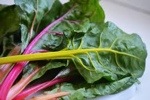
Take whatever green leafy vegetable you have – in this case, a bunch of chard.

Chop roughly and wash. No need to dry the greens before you steam them – you can leave them sopping wet.

Take a medium or large pot and add about a quarter-inch of water to the bottom of the pot. Put a steaming rack in the pot. If you don’t have a steaming rack, you can do this without, but you’ll have to watch the greens more carefully and dry them better at the end. Place your wet greens on top of the rack, and cover the pot.

Set the stove to high and let the greens steam for 2-4 minutes (depending on the green – tougher greens will take a little longer than softer ones). When the leaves turn bright green, turn off the pot and immediately remove the cover.

Move the greens to a cutting board. (If the greens are very wet, a clean rag or paper towel under them will help absorb the excess moisture before freezing, which will keep them fresher in the freezer.) Allow the greens to cool to room temperature.

Once the greens are cooled, place them in a labeled freezer bag. Squeeze the excess air out, zip it up and freeze it!

What do I do with my frozen greens? Use these just like you would use any frozen greens you bought at the grocery store. I like to throw them into casseroles, lasagnas, pasta dishes, soups for an extra hit of nutrition.

Posted in Tips and Tricks

Side Dish ‘n’ Saturdays: Lemon Cornmeal Waffles

Lemon Cornmeal Waffles

20130716-171833.jpg

Makes about 6 waffles (actual yield depends on your waffle iron)

2 cups almond milk (or other non-dairy milk)
juice and zest of 1 lemon
2 tablespoons maple syrup

1 cup cornmeal
1/2 cup whole wheat flour
1/2 cup white flour
2 teaspoons baking powder
1 teaspoon baking soda
1/2 teaspoon salt

Prep Day: Preheat waffle iron. Combine almond milk, lemon juice, lemon zest and maple syrup. Allow this mixture to sit while you combine the rest of the ingredients, so that it has a chance to curdle, making “buttermilk.” Mix the dry ingredients together. Add in the wet ingredients, and stir until well-combined. Spray the waffle iron with a bit of non-stick cooking spray, and start cooking up those waffles.

You can freeze these, wrapped individually, for quick breakfasts or snacks later on.

Serve Day: Just reheat by toasting in a toaster or oven, just like you would a store-bought frozen waffle. Serve with BBQ Chicken or Fried Chicken.

Posted in Tips and Tricks

Tips and Tricks Tuesdays: Taking Amazing Food Photos

Taking Amazing Food Photos

These days, you can’t go online without seeing pictures of delicious food. So if you want to impress your friends and learn how to photograph your food like a pro, you’re in luck! I thought I would share a few of my notes from a food workshop I took.

20130709-210950.jpg

Styling: To make you photo look professional you want to consider how it’s styled. Pick dishes that will enhance the food and let it pop. With soup use a white bowl to showcase the bright color of the food.

Also, make sure that your utensils are the right size. They shouldn’t be the focus, the food should.

Finally, consider the other props in the picture. Don’t be afraid to include props – think about what you’d want to eat or drink with the food and include that in the picture.

Angles: Shooting overhead does not give always give good, like cookies pulled right out of the oven, dimension they might need. Instead, try shooting from the side and at an angle to give the food height and dimension and added a dusting of sugar for contrast.

In general, if food is laying flat, shooting from overhead is not a bad idea especially if there is no dimension from the side. However, if you shoot from slightly higher angle or stack your food, you can create the illusion of height.

Make sure the food as a focal point which will give the viewer something specifically to specifically look at. The food should also fill the frame.

Lighting: Most of us think that when we’re in a dim restaurant we should turn out flash on. However, this is a bad idea. In fact, it’s the number one thing people do wrong. This flattens out the picture and blows out the environment.

People love taking pictures when they’re out to dinner or at a restaurant, and usually the lighting isn’t the best. If you’re one of those people try sitting near the front of the restaurant or near a window.

If it’s dark enough that you need the flash, chances are there’s a candle nearby. Move the candle closer to the food and use a menu as a bounce card to create more light.

Hope this help when photographing your food!